Diagnostics, battery and no-start, brakes, maintenance, tires and suitable minor repairs each have a dedicated page.
Demonstration audit / Mobile mechanic
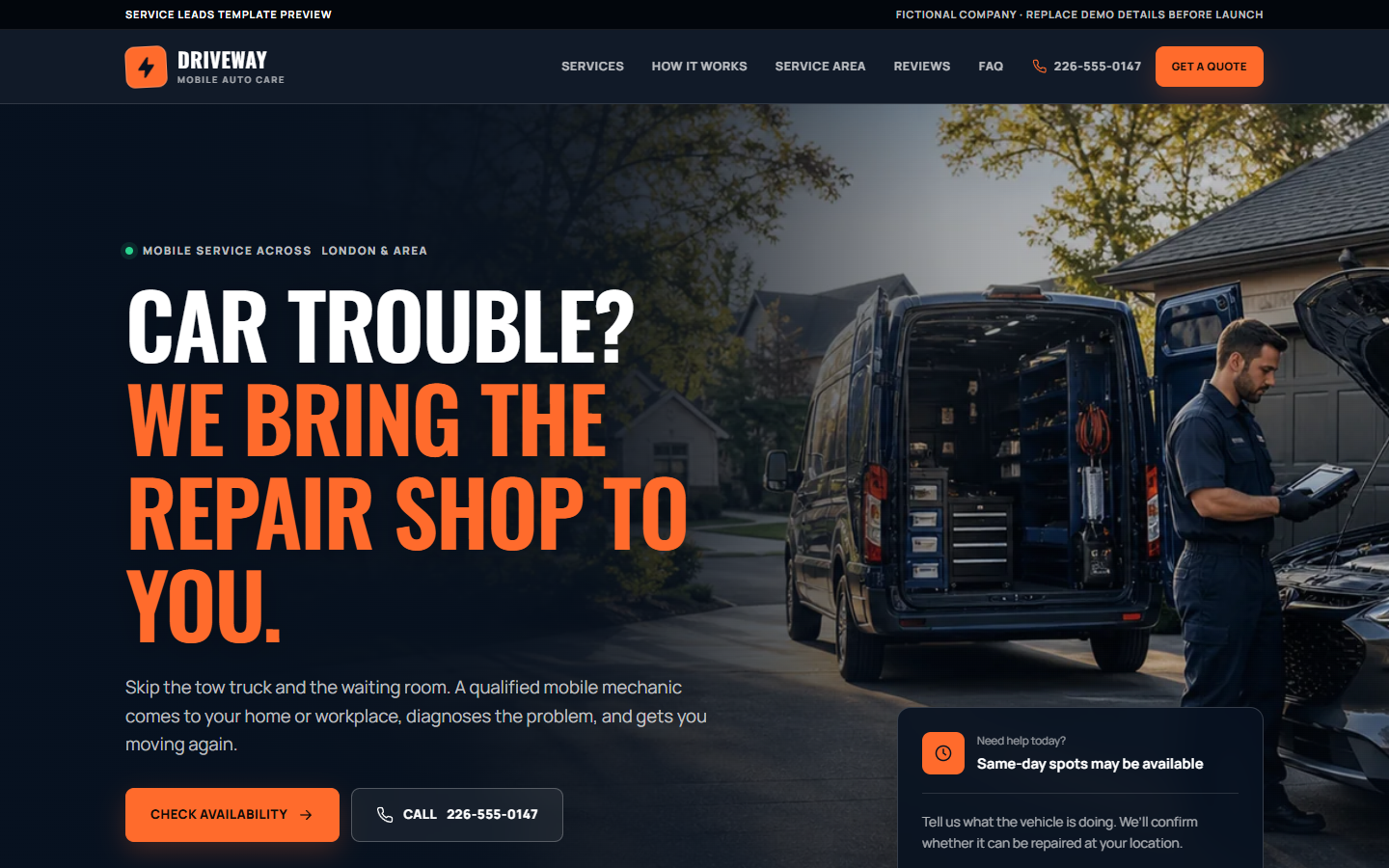
A sample Local SEO Priority Map for Driveway Auto Care.
This example shows how Service Leads would turn a website review into ordered, measurable work. Driveway Auto Care is a fictional demonstration business, so the map uses observable build evidence and makes no ranking, traffic, lead or customer claims.
Fictional businessLondon & areaFive priorities90-day plan
01 / Observable baseline
Start with what can actually be verified.
A useful audit separates the foundation that already exists from the real-business information and proof still required before launch.
The demonstration explains geographic coverage, mobile-repair fit and when a callback or different service path is needed.
The request path asks for the vehicle, symptom and location needed for a more productive first response.
The demo is noindexed and contains placeholder contact details, fictional reviews and configurable credentials that must be replaced.
02 / Ordered findings
Five priorities, each tied to evidence and a next action.
The order protects eligibility, trust and measurement before expanding the page count.
01High priority
Replace every placeholder with a verified local business fact.
Evidence
The template uses a demonstration phone number, email, service area and configurable credential claims. It has no real Google Business Profile or operating history.
Next action
Confirm the legal business name, hidden or public address rules, phone, hours, real service areas, primary category, repair limits, warranty language and approved customer policies before indexation.
02High priority
Choose the service pages that match demand and profitable work.
Evidence
Six focused routes already cover diagnostics, batteries, brakes, maintenance, tires and minor repairs. A real launch still needs to prove which services deserve the strongest emphasis.
Next action
Map the most valuable local searches to the homepage and service pages, then strengthen the first two priority routes with real pricing context, service boundaries, FAQs and internal links.
03High priority
Turn trust language into evidence a customer can verify.
Evidence
The design demonstrates space for qualifications, warranties and reviews, but those elements are intentionally labelled as configurable or fictional.
Next action
Add approved technician credentials, original job photos, real review excerpts, warranty details and short repair examples. Remove every claim the operator cannot document.
04Medium priority
Build local coverage without producing duplicate city pages.
Evidence
London, St. Thomas, Strathroy, Komoka, Thorndale and Dorchester appear as a service-area list, but the demo has no distinct evidence for each community.
Next action
Launch with one useful service-area explanation. Add a location page only when the business can provide distinct travel, scheduling, project, FAQ or customer-proof information for that area.
05High priority
Measure the hand-off from search to a confirmed job.
Evidence
The demo captures vehicle, symptom and location context, but its form is intentionally local-only and no live call or booking outcome is recorded.
Next action
Connect form delivery, call tracking and consented analytics. Record source page, requested service, response time, qualified inquiry and booked outcome without sending personal lead details to analytics.
03 / First 90 days
Fix the foundation, improve priority pages, then expand from evidence.
This is a sequencing example, not a promise of ranking movement within 90 days. Timing changes with competition, business history, proximity, proof and implementation access.
Verify the foundation
- Confirm business facts, service limits and local coverage
- Set up or align Google Business Profile, Search Console and analytics
- Create the keyword-to-page map and baseline report
- Connect forms, calls and lead-response tracking
Improve the pages that matter first
- Strengthen the homepage for mobile mechanic searches in the primary market
- Improve the first two priority service pages
- Add useful FAQs, internal links and service boundaries
- Review indexation, mobile actions and lead quality
Add proof and choose the next expansion
- Publish approved job photos or one detailed repair example
- Start a compliant review-request habit
- Support the Business Profile with accurate updates
- Use search and lead data to choose the next page improvement
04 / Measurement plan
Track discovery, customer action and the business hand-off.
A ranking report cannot show whether an inquiry was useful or answered. The monthly view should connect search visibility to the next operational result.
- Discovery
- Search impressions, clicks, priority-query movement and Business Profile actions.
- Customer action
- Calls, completed requests and conversion rate by landing page and service.
- Lead quality
- Service fit, geographic fit, urgency and enough vehicle context to continue.
- Response
- Time to first useful response, confirmed appointment and booked job when available.
What this sample does not claim
No real business was audited, no keywords were tracked, no Google Business Profile was reviewed and no customer outcomes were measured. This page demonstrates the format, reasoning and evidence standard Service Leads would apply.
Your business / real evidence
Get a Priority Map built around the website and lead path you have now.
Send your current website and describe the services and locations that matter most. Dave will identify the first practical priorities and explain what should happen next.