
What local SEO is trying to do
Local SEO is the work of making a business easier to discover and easier to choose when a customer searches in a specific area. For a plumber, roofer, cleaner, mechanic or other service business, the useful outcome is not a ranking report. It is a qualified call, quote request or booking from someone the company can actually serve.
That customer may find you through a map result, an ordinary search result, a business directory or an AI-assisted search experience. The path changes, but the questions stay familiar: Do you handle this problem? Do you serve my location? Can I trust you? What happens after I contact you?
Strong local business SEO services answer those questions consistently across the Business Profile, website, reviews and other trusted references. When one part contradicts another, the customer has to work harder to decide.
- Describe the services customers actually ask for.
- State the real service area without inventing locations.
- Show credible proof and answer common buying questions.
- Make calling or requesting service simple on a phone.
Work with relevance, distance and prominence
Google says local results are mainly based on relevance, distance and prominence. Relevance is how closely the business matches the search. Distance considers how far the business is from the searcher or named location. Prominence reflects how well known and well supported the business appears online and offline.
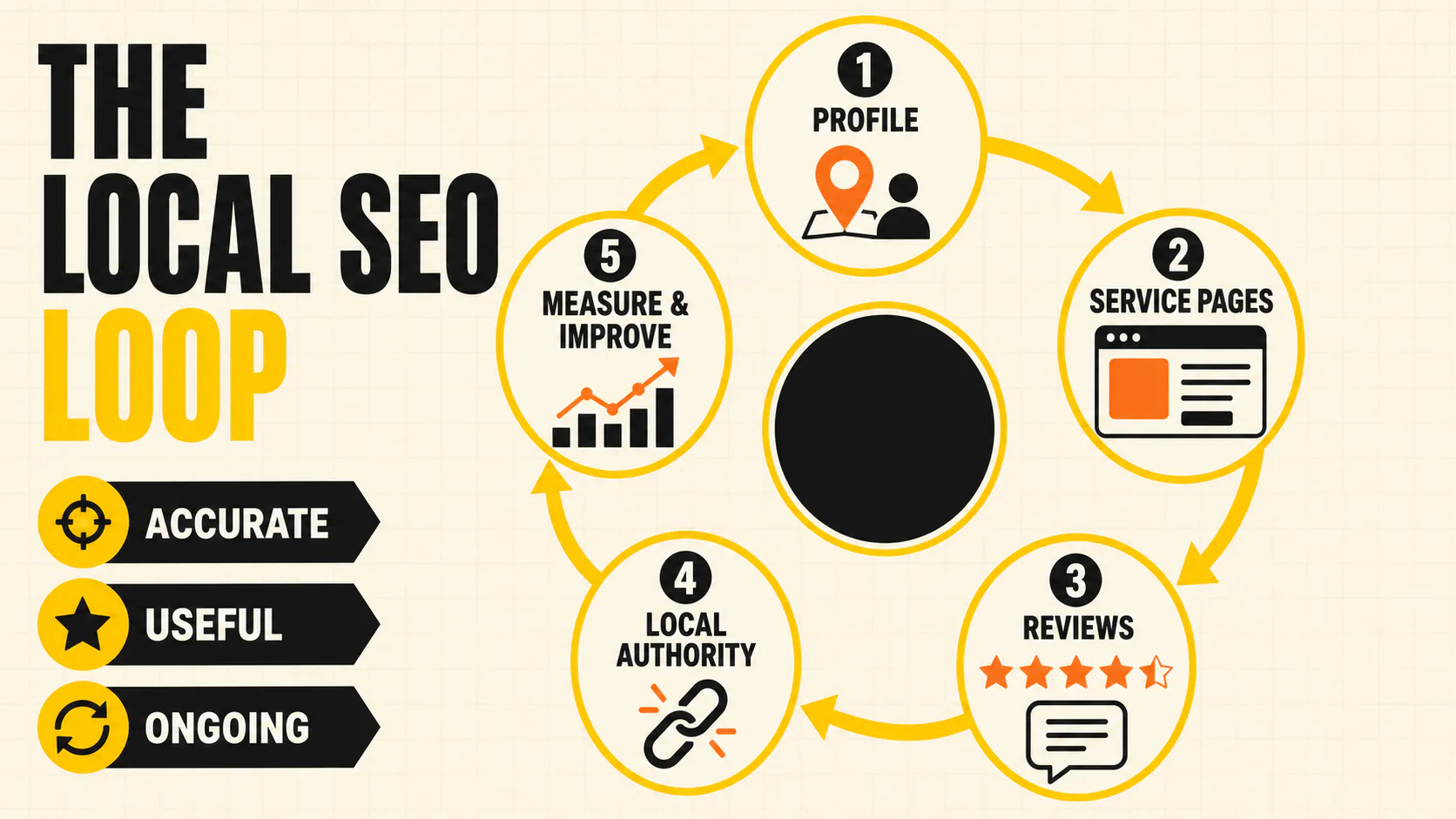
A practical strategy improves what the business can control. Clear categories, services and pages strengthen relevance. Reviews, links, articles and other credible references can support prominence. Distance is different: a business cannot honestly optimize a suburban address into a downtown location.
This is why local SEO should be treated as a connected loop instead of a collection of tricks. Accurate profiles, useful service pages, authentic reviews, local authority and regular measurement reinforce one another.
Related system: Local SEO Growth ↗
Make your Business Profile accurate
Start with a verified Business Profile that reflects the real business. Use the actual business name, the fewest accurate categories, current hours, a working phone number, the correct website and a service list that matches what the team can deliver.

Service-area businesses need special care. If customers are not served at the business address, Google says the address should be hidden and the real service areas should be entered instead. A service-area business generally gets one profile for the area it serves; virtual offices and made-up locations create unnecessary suspension risk.
Photos should help a customer understand the people, equipment, work and experience. Add useful images when the business has something real to show. There is no reliable universal rule that a photo must be posted every seven days or that a profile-strength meter guarantees better rankings.
- Confirm name, phone, website, hours and service area.
- Choose categories for the real core business—not as keyword storage.
- Remove an address customers cannot visit.
- Document profile access and keep ownership with the business.
Build a review system people can trust
Reviews help customers compare businesses and can contribute to local prominence. The sustainable approach is simple: ask real customers for honest feedback, make the review link easy to access and respond with the same care you would use in a customer conversation.
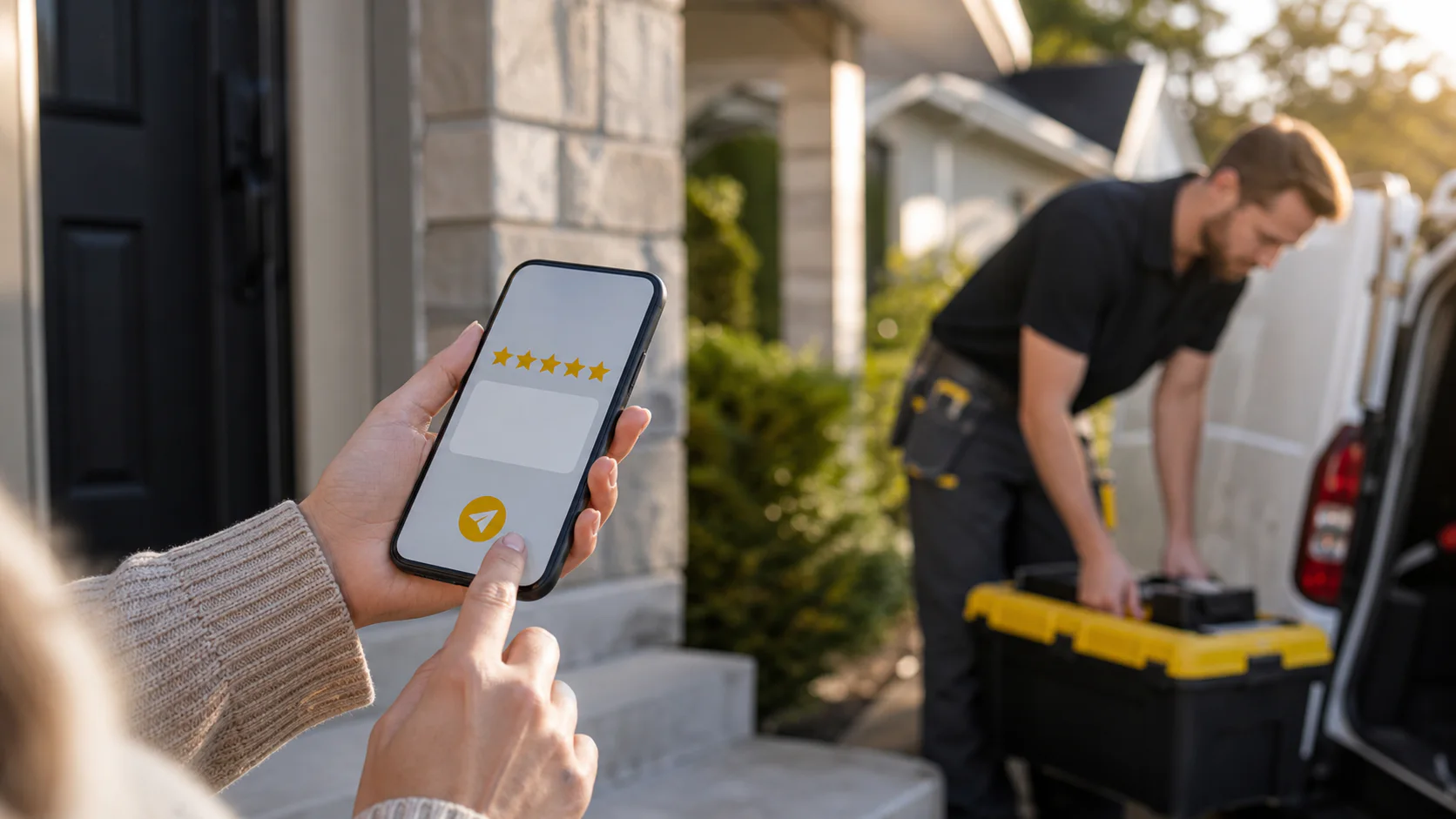
Do not buy reviews, offer discounts in exchange for them or prevent unhappy customers from seeing the public review option. Google prohibits incentives for posting, changing or removing reviews. A balanced review history from genuine customers is more credible than a suspicious burst of perfect ratings.
Avoid scripting customers to repeat a city and service keyword. You can ask what stood out about the work, but their words should remain their own. The goal is useful proof for the next customer—not manufactured search copy.
- Send the request shortly after the work is completed.
- Use one direct review link or QR code.
- Invite honest feedback without offering a reward.
- Respond calmly and specifically to both positive and negative reviews.
Create service and location pages worth landing on
A Business Profile can earn attention, but the website often finishes the decision. Important services deserve focused pages that explain the problem, scope, process, service area, proof, common questions and next step. A generic list of services rarely gives a customer enough confidence to call.
Location pages should exist only when they add real local value. A strong page may explain travel or scheduling, neighbourhood-specific considerations, relevant projects, service limits and customer questions from that area. A weak page swaps one city name for another while leaving every other sentence unchanged.
Link related service, area and educational pages so the customer can move naturally through the site. Titles and headings should use the language customers search, but the page still has to read like it was written for a person.
- Give each important page one clear search intent and conversion goal.
- Use real photos, examples and policies the business can verify.
- Avoid duplicate city pages and pretend offices.
- Add LocalBusiness structured data when it accurately describes the entity.
Strengthen local authority without citation busywork
Citations are references to the business name, address and phone on other websites. Accuracy matters, particularly on major platforms and industry directories customers use. But harmless formatting differences such as “Suite” and “Ste.” are not a reason to rebuild the entire web.
Prioritize the sources that can confirm the business or send a real customer: Apple Maps, Bing Places, established directories, trade associations, local chambers and relevant industry platforms. Then look for earned local links and mentions through suppliers, sponsorships, partnerships, community work and genuinely useful resources.
Ten relevant local references can be more valuable than hundreds of automated listings on sites nobody visits. The question is not how many citations were purchased. It is whether the business looks consistent, established and connected to its market.
Prepare for AI-assisted local discovery
Customers increasingly ask AI tools for recommendations, comparisons and explanations. The safest response is not a separate bag of AI tricks. It is to make the business easy to understand across crawlable pages and credible third-party sources.
Keep service descriptions, location information, policies, author details and proof clear. Use structured data to describe facts—not to create claims the page cannot support. Publish direct answers to the questions customers ask before buying, and keep important information available as text rather than hiding it inside images.
AI visibility is still evolving, so treat it as another discovery surface to monitor. Do not sacrifice accurate local SEO foundations for promises of guaranteed citations in an answer engine.
Measure leads, not just rankings
Local rankings vary by location, device, wording and time. A geo-grid can help diagnose neighbourhood visibility, but a single colourful report is not the business outcome. Connect website forms, click-to-call actions and qualified inquiries to the pages and sources that produced them.
Review the full hand-off. If visibility rises but calls go unanswered, forms lack useful details or estimates receive no follow-up, the problem has moved downstream. Local SEO works best when the website and lead-response system improve with it.
- Track calls, forms and booked estimates separately.
- Review Business Profile performance and website conversions.
- Compare lead quality by service and landing page.
- Record response time and the final booked outcome.
- Improve weak pages based on real customer behaviour.
How to evaluate local SEO services
Canadian keyword demand clusters around terms such as local SEO services for small business, local business SEO services, affordable local SEO services, local SEO services Canada and local SEO Ontario. Those searches show commercial intent: owners are comparing providers, scope and value—not looking for another vague checklist.
When comparing a local SEO company, consultant or agency in Canada, ask what will change on the website, who owns the Business Profile, how service and location pages will be chosen, which outcomes will be measured and what the business must provide. “Affordable” should mean a focused scope with clear priorities, not automated pages, fake locations or a monthly report with no connection to leads.
A credible provider should be comfortable explaining what it cannot control. Nobody can guarantee a Map Pack position. The practical promise is a stronger, more accurate system for being discovered, evaluated and contacted by customers in the areas the business really serves.
- Is the strategy tied to profitable services and real service areas?
- Will the business retain ownership of its domain and profiles?
- Are content, review and location tactics policy-compliant?
- Does reporting connect visibility to qualified inquiries?
- Are deliverables, timelines and responsibilities written clearly?